Shoes play a crucial role in our lives every day and everywhere. The right shoes help us travel comfortably, run faster, and jump higher, acting as shock absorbers.
Markers of hard work, high fashion, and sexual allure, they are powerful tools for self-expression and social and cultural signaling.
But they have also been the basis of spooky myths, strange habits, and even royal snobbery. And the people who make shoes — from the early cobblers working at their benches by candlelight to the modern oddball specialists whose story is told in the movie Kinky Boots — are some of history’s most creative artisans.

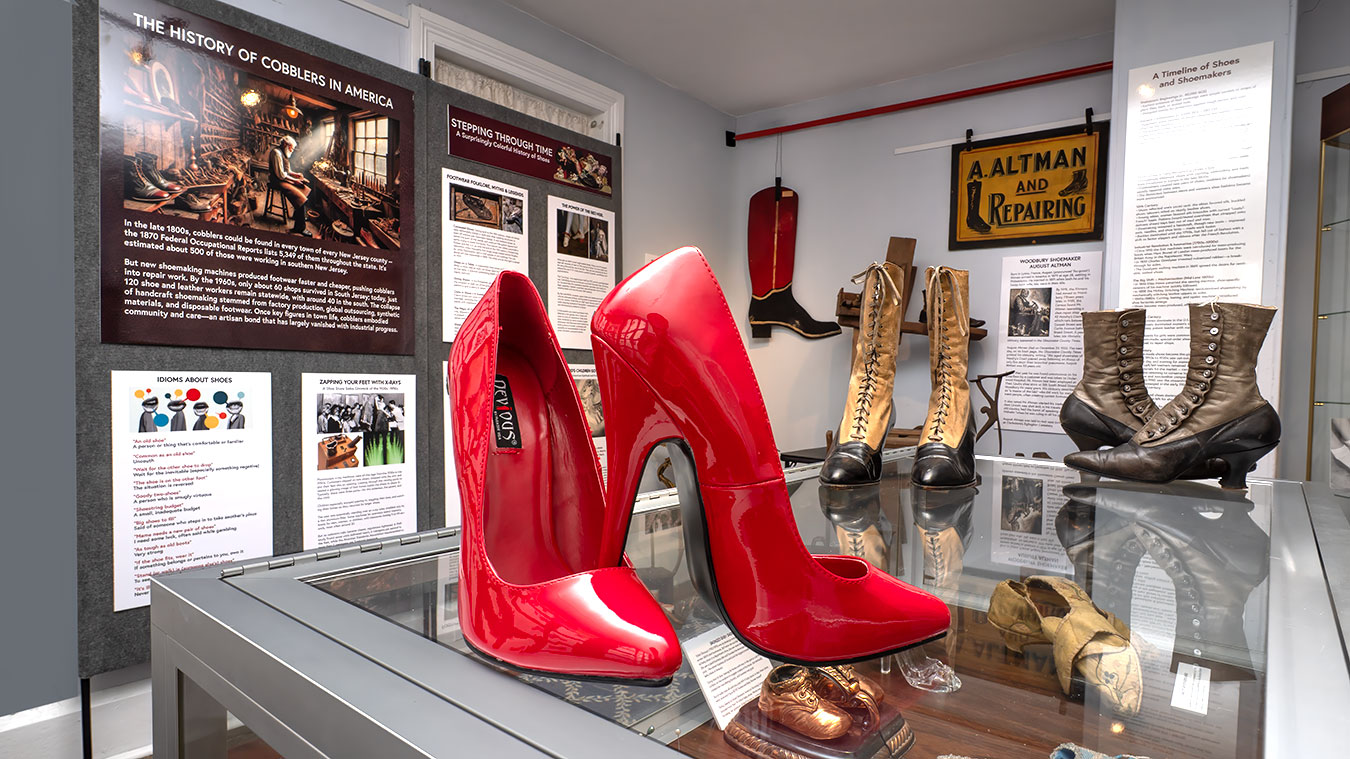
All these dimensions of footwear and more come vividly to life in the Gloucester County Historical Society’s new exhibit, “STEPPING THROUGH TIME: A Surprisingly Colorful History of Shoes,” now open to the public.
“Our archives literally step back centuries through time,” said Sandy Levins, Co-Chair of the Society’s Museum Committee. “They are rich with shoes as well as tools and artifacts reaching back into the 1700s.”

One of the more unusual objects on display is the beaded moccasins of Chief Iron Tail, leader of the Oglala Lakota. Gaining fame as a performer in Buffalo Bill’s Wild West Show in the 1890s, his profile appears on the U.S. Buffalo (Indian Head) nickel, minted from 1913 to 1938.
Levins also pointed out there is a music of shoes — songs that celebrate the symbolism, sensuality, and even the heavenly nature of footwear, from Elvis Presley’s “Blue Suede Shoes” and the African American spiritual “All God’s Children Got Shoes,” to Nancy Sinatra’s “These Boots Are Made for Walkin’” and Paul Simon’s “Diamonds on the Soles of Her Shoes.”
Similarly, she noted that allusions to shoes are woven throughout everyday language, such as “waiting for the other shoe to drop,” “shoestring budget,” and “if the shoe fits, wear it.”

The exhibit also underscores how dramatically the making, selling, and repairing of shoes has changed over the last 250 years. In the 19th century and the early half of the 20th century, there were cobbler shoe repair shops in virtually every community. New Jersey had more than 5,300 of them in 1870. But like so many handcraft industries, this one was decimated by the rise, in the second half of the 20th century, of a throwaway economy that no longer valued the long-term use or repair of shoes. In 2023, there were fewer than 40 commercial shoe repair and leather shops left in southern New Jersey.
The Historical Society Museum, located in downtown Woodbury, is open Tuesdays from 6 to 9 pm; Wednesday through Friday from noon to 4 pm; and the third weekend of every month (Saturday and Sunday), noon to 4 pm. Admission is free for members and $5 for non members. Visit them online at www.gchsnj.org.