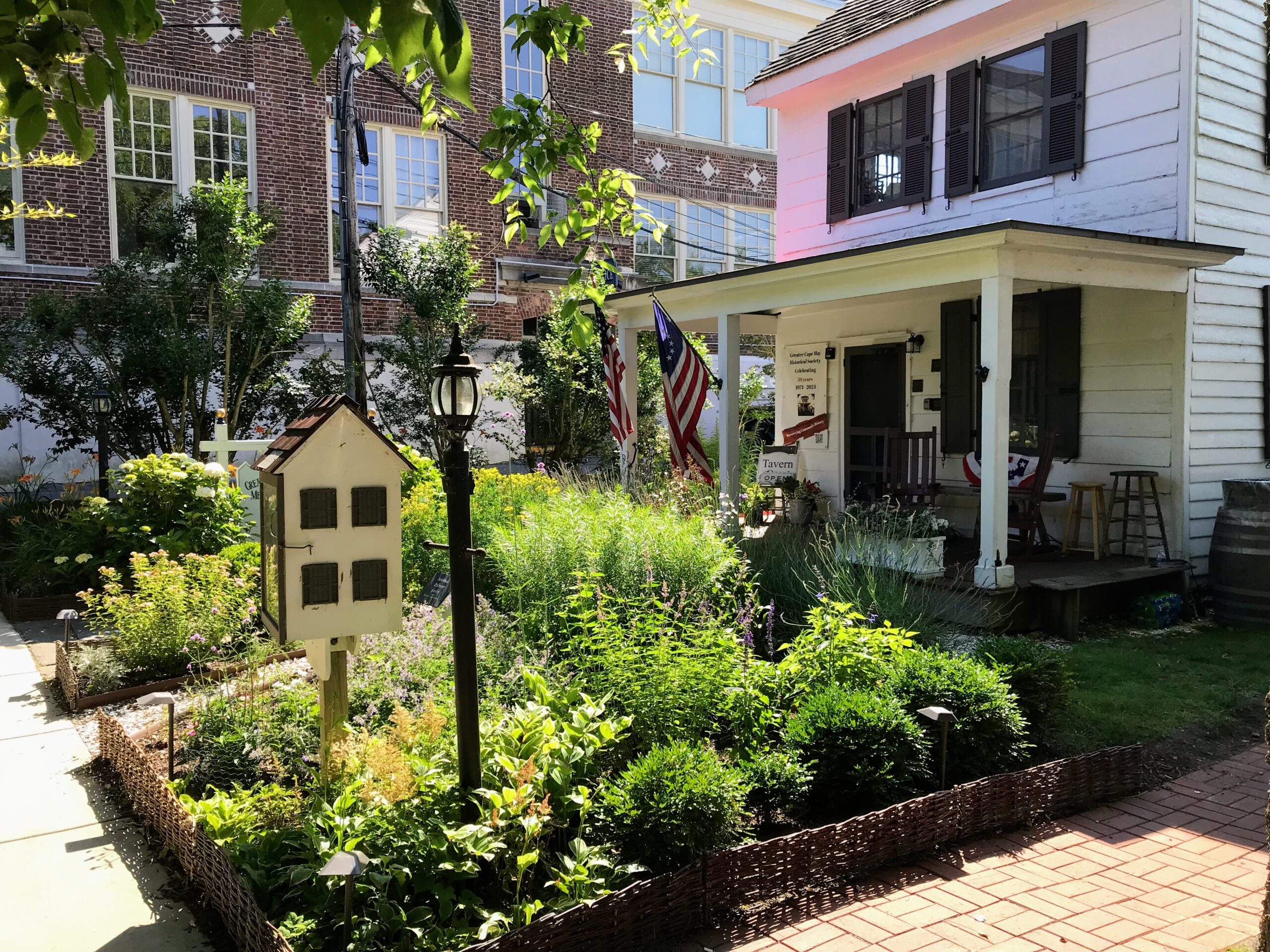
As part of our new “Historical Perspectives” series we reached out to the folks at the Greater Cape May Historical Society, who provided us with this history of the building that houses their headquarters. Stop in for a visit the next time you find yourself in “The Nation’s Oldest Seashore Resort.”
Located between City Hall and Cape May’s new firehouse, the Colonial House is one of Cape Island’s oldest public residences. Now home to the Greater Cape May Historical Society and Museum, the house was saved from demolition by the Society and has survived three relocations. Also known as the Memucan Hughes House, it is named for its likely Revolutionary War-era owner.
The house exemplifies vernacular architecture, built with local materials and traditions between 1730 and 1760, though its exact age is unclear due to later interior changes. Victorian-era rafter techniques and other structural evidence suggest it is a first or second period colonial building, unique on Cape Island and a valuable piece of Cape May’s history.
Some exterior features, such as extra-wide soffit boards and original ship-lapped siding potentially made from Carolina cypress, imply pre-1800 construction. These elements differ from typical 19th-century Cape May houses and merit further research to confirm the use and availability of cypress in the area. The floor plan analysis supports early dating, with its uncommon two-room-deep layout like only two other surviving first-period houses in Cape May County: The John Hand House and the Thomas Leaming House.

The Colonial house served as a tavern for whalers and locals, operated by Memucan Hughes until about 1800. Hughes’s tavern license from 1765 helps date the building’s construction. Taverns at that time were essential public spaces for socializing, business, sharing news and court rooms. They connected rural residents to their communities, acted as hubs for political and economic information, and played a vital role in early American society to discuss the revolution against the King and the battles fought up North in the Crossroads of the Revolution.
The Hughes family were early settlers in New Jersey, with William Hughes and his wife Dorothy purchasing land in 1674. Their descendant, Memucan Hughes (born 1739), moved to Cape May in 1761 after serving as an officer in the Pennsylvania artillery. He joined the Safety Committee and became a paymaster during the war. Along with his brother Ellis, they operated taverns and boarding houses in Cape May, which served as vital stops for travelers and sources of news. Ellis was the first to promote Cape Island as a vacation destination through advertisements in Philadelphia newspapers.
In 1799, Memucan was indicted for causing a public nuisance. Evidently there was just too much merrymaking at the tavern. Memucan did find religion and invited two Methodist preachers to hold services in the tavern. In 1810, he helped to establish the Cape May Methodist Church. He donated land to the Tabernacle Methodist Church in Erma, just north of Cape May, where he is buried.
Cape May County’s African American experience with the Methodist Episcopal Church is part of Memucan’s legacy. The Hughes family was one of the largest slave-owning families in Lower Township. The Hughes family manumitted their slaves by giving them land for a meeting house. Memucan married twice. He married Rhoda Allen in 1799. Memucan was a citizen, soldier, patriot, and entrepreneur. In the latter part of his life, he “suffered much continued bodily affliction.” Memucan died in 1812.
The Colonial House is free and open to the public June 15 to September 15th- Wednesday through Saturday from 1:00 to 4:00 p.m.
The Society is planning for the 250th celebration as an authentic revolutionary historical site in Cape May County. For more information, email the Society with history questions at [email protected], and visit www.capemayhistory.org.
Funding for the organization has been made possible in part by the New Jersey Historical Commission / Department of State, and The Cape May County Board of County Commissioners through the Division of Culture & Heritage.