On the morning of June 29, 1776, an often-overlooked battle of the American Revolution took place off what today is Wildwood Crest, in a body of water that no longer exists.
It would come to be known as the Battle of Turtle Gut Inlet, and it would be the only battle of the Revolutionary War to take place in Cape May County.
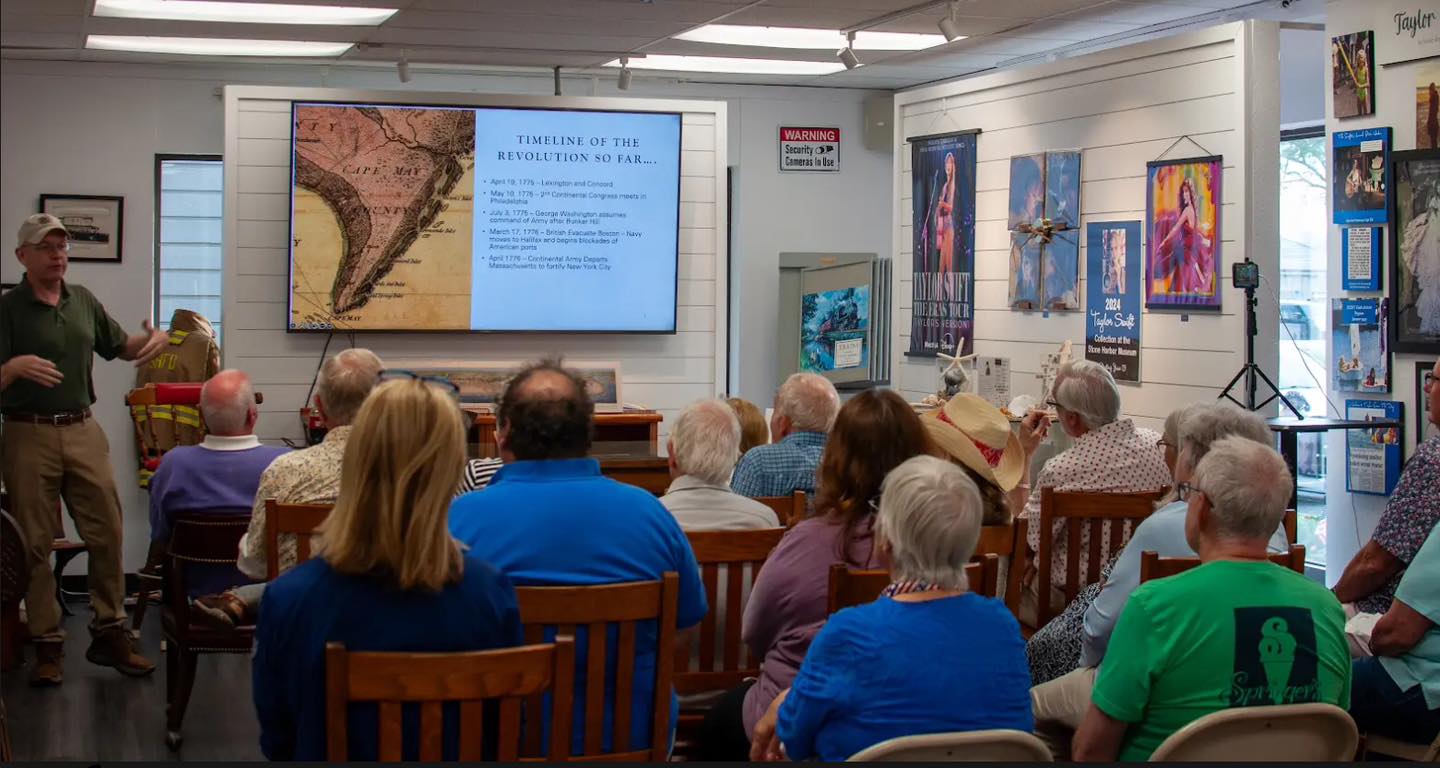
John Ryan, the chief operating officer at Historic Cold Spring Village, recently gave a presentation on the battle at the Stone Harbor Museum.
The fight began when the sailing ship Nancy, which had been commissioned to transport supplies for the American war effort, caught the attention of British ships that had set up a small blockade in the Delaware Bay.
The American Sailing Vessel Brigantine Nancy

Ryan said the Nancy had just come back from the Caribbean with 386 barrels of gunpowder, 55 muskets and 101 hogsheads of rum, among other supplies it was attempting to deliver to Colonial forces in Philadelphia.
A trio of American ships, Ryan said, led by John Barry, who would go on to be one of the founders of The U.S. Navy, and who is the namesake of Commodore Barry Bridge, came to Nancy’s assistance.
But the American forces decided the best course of action was to board the Nancy, run it aground along the nearby barrier islands and offload the cargo onto land.
They made their move by entering Turtle Gut Inlet, a narrow body of water that ran from the Atlantic Ocean into the back bays through what is today Wildwood Crest. The area that is now known as Diamond Beach, or Two Mile Beach, was at this time a distinct island separated by the inlet, which has since been filled in.
The British, Ryan said, caught up to them and started blasting away at the Nancy, as crews worked to unload her supplies onto land.
“It’s at this point, John Barry develops an alternate plan,” Ryan said. “He’s going to set a trap – what I kind of refer to as the Wyle E. Coyote moment of the American Revolution.”
He said around 120 barrels of gunpowder remained onboard, and Barry ordered 40 barrels to be placed in the captain’s cabin. Ryan said the crew then took one of the ships’ sails, lined it along the deck and filled it with gunpowder, creating a fuse.
The Colonial crews were ordered to abandon ship and then they waited as the British approached with plans of capturing the Nancy and her supplies.
“Just as they are boarding the Nancy, the fuse hits the gunpowder, creating an explosion that supposedly was heard in Philadelphia,” said Ryan, who then cautioned that that particular detail may be more a piece of folklore than fact.
Many British sailors were killed and the rest retreated after the blast, Ryan said.
He said the Nancy’s salvaged supplies did eventually make their way to Philadelphia to be used in the war effort, and the rest as they say, is history.
Turtle Gut Inlet is no longer there today as it was completely filled in by the 1930s, partly because it was becoming too shallow to navigate, Ryan said, and partly out of the desire for additional land to build more new houses in the growing coastal communities.
Dedicated Plaque in Wildwood Crest

There is a memorial to the battle alongside Sunset Lake, near Miami Avenue in Wildwood Crest, in case you’d like to get a sense of exactly where this battle took place. For more information on the battle, and other history programs, please visit the Stone Harbor Museum at www.stoneharbormuseum.org and Historic Cold Spring Village at www.hcsv.org.
The Stone Harbor Museum often live streams their “Museum Talk” presentations on local history on their Facebook page.
Find them at www.facebook.com/stoneharbormuseum for even more great programming.
Their next Museum Talk, Stone Harbor During WWII takes place tonight, July 9, at 7 p.m. Admission is free to attend in person or to watch live onlin
Check out last week’s talk on the Battle of Turtle Gut Inlet here!